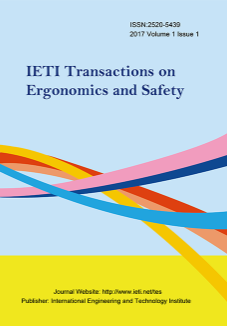
IETI Transactions on Ergonomics and Safety special issue addresses COVID-19

Following the consistent striving of the FEES, IEA, and our ergonomics community on the prevention of the pandemic, we wish to inform you that recently has been published a special issue of the Following the consistent striving of the FEES, IEA, and our ergonomics community on prevention of the pandemic, we wish to inform you that recently has been published a special issue of the IETI Transactions on Ergonomics and Safety journal.

IETI Transactions on Ergonomics and Safety serves ergonomics in the limitation of virus spreading and alleviation of pandemic effects. 

This IETI Transactions on Ergonomics and Safety special issue addresses COVID-19 virus first in any international journal from the domain of ergonomics. Together with other exciting matters here, you can find why the role of ergonomics is essential when it comes to the prevention of spreading the COVID-19 virus at workplaces.

Pilot testing of Train4Work

train4workThe TRAIN4WORK project begins pilot tests in March 2020.

If you are

  • an engineer responsible for workplaces, process and production design
  • an engineer responsible for machinery, working equipment and tools design
  • a Health and safety manager
  • a consultant who provides services related to these issues to the industry
  • a human resources professional (recruitment and job assignment of workers)
  • a student learning ergonomics and human factors
  • or you are any way interested

SIGN UP FOR THE TRAIN4HCWORK PILOT COURSE FOR FREE!

To apply, all you need to do is:

  • Create your profile at IBV CAMPUS VIRTUAL
  • Confirm your interest in joining the TRAIN4HCWORK pilot course by emailing Raquel Portilla (campus.ibv@ibv.org) with the following details:
    • First and last name
    • Email contact
    • Occupation
    • Country of residence
    • Also, please place “TRAIN4HCWORK COURSE – IBV” in the subject of your message.For more information, please refer to the course learning guide and the pilot flyer

    FFES LogoProject supported by the European Union
    Contract Number: 2018-1-ES01-KA203-050887

Online TRAIN4WORK questionnaire

train4workThe project TRAIN4WORK launched an online questionnaire on 13 February 2019 to identify training requirements and define learning objectives and the course structure of new learning material.

The questionnaire aims to gather data to support the development of the online training course, which targets all those involved in the design (or re-development) of work systems but are not ergonomics and human factors specialists.

The questionnaire can be accessed in four different languages

The questionnaire will be open until March 31.

TRAIN4WORK is an initiative of the Federation of European Ergonomics Societies under the umbrella of Erasmus+ to create freely accessible online ergonomics training material.

FFES LogoProject supported by the European Union
Contract Number: 2018-1-ES01-KA203-050887

ERGONOMIST TO MANAGE DANGEROUS SUBSTANCES BETTER

The “Manage Dangerous Substances” EU-OSHA workplace health and safety campaign was launched on April 2018 and following traditions the Federation of European Ergonomics Societies (FEES) become an official campaign partner again.

FEES dedicates the 2018 / 19 European Month of Ergonomics – “ERGONOMIST TO MANAGE DANGEROUS SUBSTANCES BETTER” to identify, elaborate and demonstrate how ergonomic profession can contribute to the healthy and safe handling of hazardous substances.

FEES encourages ergonomist and their networks or organisations to join in, organise events, sessions, press conferences, communicate and promote the ergonomics profession capabilities.

The Communication and Promotion Committee of FEES calls educational institutions to initiate research and development programs, in particular student projects, master thesis and PhD works to produce solutions of high ergonomics quality in regard of management of hazardous substances, and submit these result to the The Healthy Workplaces Good Practice Awards

FEES campaign activity has begun May 24, 2018, in Poznan at the Polish Ergonomics Society seminar, when Gyula Szabó, chair of Communication and Promotion Committee of FEES presented the initial EME communication package. The “ERGONOMIST TO MANAGE DANGEROUS SUBSTANCES BETTER” ppt presentation downloadable from this page, and can be used at EME related activity in October at the EME period, and around the year when feasible.

FEES proposal on “Future of work”

FEES proposes the member societies implement the IEA “future of work project in Europe, which means:

  • To create a FEES Task Force “future of work”
  • To name in each member society a referee on this issue, which tasks are:
    • To lead and moderate the reflection
    • To inventory the research centers and private or public bodies involved in this issues: detecting local, national, regional data on issues affecting the working life; employment and job trends from governmental reports and from employers and workers organizations; research papers from academia.
    • To spread information on the issue
    • To get in touch with the ILO offices in the European countries in order to make known the project and to envisage everyday actions, to capture ILO initiatives, data, reports, publications.
    • To make proposals in order to improve and develop the initiatives proposed by the IEA “future of work” task force.
    • To meet by skype and physically (at the latest during the IEA triennial congress in Florence – August 2018)
  • To set up an European observatory on the Future of work linked with the IEA observatory.
    The aim of the Observatory is to capture and report data and news of ergonomics interest about trends on the world of work identified in each country in order to create an ergonomics observatory unit in (geographical) Europe.
  • To prepare the initiatives to set up in the year 2019 with ILO.

Please send comments / proposals to Pascal Etienne secretary-general@ergonomics-fees.eu.

The IEA “future of work project (summary)

IEA has decided to be involved in the ILO project on the future of work, launching a reflection conducted by a task force whose leader is our colleague Juan Hiba, from Argentina. In two documents released in January 2018, our colleague make proposals which are sum up below.

It is important that FEES, in the frame of the MoU adopted with IEA, takes part in this project and sets up a FEES task force in order to specify actions to conduct in 2018, 2019 and maybe further. We will present below both IEA projects and the possible way of working on this issue for the FEES member societies.

Two proposals have been made by J. Hiba on behalf of the « future of work » task force: to set up a White paper on the future of work and an Observatory. They are sum up below.

The “White paper on the future of work”

Context – Rationale – Opportunities

This initiative links the prospects of the future of ergonomics as a science and technology with the ILO initiative of its centenary named “The Future of Work” and could be a roadmap for guiding IEA’s and its affiliated associations on how to gain ILO interest for paying more attention to ergonomics from now on. A strategy should be developed to ensuring that the White Paper reaches all the ILO levels: headquarters and in the field.

Structure and content of the white paper

1 Presentation of ergonomics as a science and technology; (ii) summary of the background of joint activities carried out; and (iii) focus on the concurrent circumstances of the future of ergonomics and the future of work and therefore the opportunity for discovering key aspects of common actions.

2 Visions and proposals of IEA in relation to each of the four global dialogues (also called “centenary conversations”) as requested by the ILO are:

  • Work and Society: new scenario; changes in the workers and employers’ identity; globalization; new digitalized technologies and communications; hyperconnectivity.
  • Decent Jobs for All: full employment; safe and free productive work, social protection, union rights, remuneration.
  • The Organization of Work and Production: to tackle issues of the emerging platform economy, global supply chains and the nature of the enterprises of the future
  • The Governance of Work: to identify the rules, processes, and institutions needed in the future to make work decent and societies just.

A special attention should be given to point out the links of ergonomics to the most current issues of interest to the ILO, such as the green economy, the phenomena of offshoring of companies, jobs in the computer world, robotization of many jobs, issues of safety and health at work and participation of workers in the processes of improving their working conditions.

3 The current convergence of common grounds of action between IEA (“ergonomics optimizes human well being and overall system”) and ILO (: “Promoting jobs, protecting people”) – a comparative list of work topics and productive sectors of interest for ergonomics and for the ILO – a selection of successful case studies showing ergonomics interventions in different regions of the world. These examples should show both benefits to workers (i.e. satisfaction, better labor relations and working conditions) as well as improved business productivity and sustainability. It is highly recommended that case studies come from different world regions (Asia, Europe, Latin America and Africa),

4 list a series of tentative activities and initiatives offered to ILO.

5 Collaborators mentioned : Yushi Fujita, Kathleen Mosier, José Orlando Gomes; Andrew Todd, Thomas Alexander, Sarah Sharples, Juan Carlos Hiba, + Sara Albolino and Valérie Pueyo.

6 Language of the document: the three official languages of ILO: English, Spanish and French.

The Observatory

The aim of the Observatory is to provide periodic information on situations, trends and work cases that establish, set or modify different aspects of the quality of life of workers; to give support and encourage carrying out of studies and research on ergonomic aspects of quality of life of workers in the local socio-economic and labor environments; and to promote greater knowledge (principles and values) and disseminate examples of application (approaches, methods and technical tools) of ergonomics and human factors for improving the quality of working life.

The Ergonomics Observatory can develop activities of at least three types

  • Search and analysis of information of ergonomic interest such as detecting, identifying, analyzing and commenting on changes and/or innovations that have occurred in the field of quality of life at work that are of interest to ergonomics;
  • systematic communication of detected information (data, facts and figures, situations, trends and cases) related to the quality of work-life; and
  • launching warnings, calls for attention and organizing advocacy actions among stakeholders to ensure that ergonomics is more and better known and to disseminate the potential contributions that could be made in those cases.

Information sources

Journalistic notes, interviews and articles from scientific works of refereed journals; reports, or books from research centres; publications of governmental agencies; declarations or manifestos emanating from scientific congresses, reports from employers’ and workers’ organizations; regulation in collective agreements or laws, decrees, resolutions and reports adopted by governments or specialized agencies.

Users

National ergonomics associations, their members and professional, teachers, researchers, officials from governments, members of employers’ and workers’ organizations; news agencies ; employers, workers and public in general.

Related content

FEES proposal on “Future of work”

FEES proposes the member societies to implement the IEA “future of work project in Europe, which means: …

Future of ergonomics in Europe

Future of ergonomics in Europe: from health and safety managment to sustainability developmentFEES Session at the 50th Anniversary Congress of …

STREAMLINING THE PRODUCTION PROCESS AND REDUCING STRESS

Bernard Michez and Samuel Le Gal
www.ergotec.fr

About ERGONOMICS PRACTICE EXAMPLES

The field of practice of professional ergonomists is very wide and covers all aspects concerning the health, well-being and productivity of people at work. Some ergonomic interventions concentrate on designing workplaces so that the work can be done comfortably and safely over a long period. Others look at the safety and ease of use of tools and computer interfaces. Others look at the organization of work systems to optimize workflow and avoid errors.

These papers do not cover all the areas of ergonomics practice, but they may be helpful for people looking for examples of how a professional ergonomist provides solutions for companies wanting to improve the efficiency of their workers without decreasing their safety, health, or well-being.

CONTRIBUTORS

The examples published here were contributed by European Ergonomists and reviewed by representatives from the Centre for Registration of European Ergonomics (CREE) and by the Federation of European Ergonomics Societies (FEES).

FFES Logo

If you are a certified ergonomist and wish to contribute, please get in touch with a member of the executive board of CREE or FEES. Contributions are welcome, and no fee is charged.

No posts found.

DECREASING MUSCULO-SKELETAL DISORDERS OF SEATED WORKERS

Nicolas Draye, Haute Ecole Louvain en Hainaut
drayen@helha.be

About ERGONOMICS PRACTICE EXAMPLES

The field of practice of professional ergonomists is very wide and covers all aspects concerning the health, well-being and productivity of people at work. Some ergonomic interventions concentrate on designing workplaces so that the work can be done comfortably and safely over a long period. Others look at the safety and ease of use of tools and computer interfaces. Others look at the organization of work systems to optimize workflow and avoid errors.

These papers do not cover all the areas of ergonomics practice, but they may be helpful for people looking for examples of how a professional ergonomist provides solutions for companies wanting to improve the efficiency of their workers without decreasing their safety, health, or well-being.

CONTRIBUTORS

The examples published here were contributed by European Ergonomists and reviewed by representatives from the Centre for Registration of European Ergonomics (CREE) and by the Federation of European Ergonomics Societies (FEES).

FFES Logo

If you are a certified ergonomist and wish to contribute, please get in touch with a member of the executive board of CREE or FEES. Contributions are welcome, and no fee is charged.

No posts found.

COMBINING THE EXPERTISE OF WORKERS WITH OBJECTIVE MEASURES

Veli-Matti Tuure
www.tts.fi

About ERGONOMICS PRACTICE EXAMPLES

The field of practice of professional ergonomists is very wide and covers all aspects concerning the health, well-being and productivity of people at work. Some ergonomic interventions concentrate on designing workplaces so that the work can be done comfortably and safely over a long period. Others look at the safety and ease of use of tools and computer interfaces. Others look at the organization of work systems to optimize workflow and avoid errors.

These papers do not cover all the areas of ergonomics practice, but they may be helpful for people looking for examples of how a professional ergonomist provides solutions for companies wanting to improve the efficiency of their workers without decreasing their safety, health, or well-being.

CONTRIBUTORS

The examples published here were contributed by European Ergonomists and reviewed by representatives from the Centre for Registration of European Ergonomics (CREE) and by the Federation of European Ergonomics Societies (FEES).

FFES Logo

If you are a certified ergonomist and wish to contribute, please get in touch with a member of the executive board of CREE or FEES. Contributions are welcome, and no fee is charged.

No posts found.

PARTICIPATORY REDESIGN OF A PUBLIC PARK IN THE CITY OF NAPLES

Dr Erminia Attaianese Eu.Erg.
erminia.attaianese@unina.it

About ERGONOMICS PRACTICE EXAMPLES

The field of practice of professional ergonomists is very wide and covers all aspects concerning the health, well-being and productivity of people at work. Some ergonomic interventions concentrate on designing workplaces so that the work can be done comfortably and safely over a long period. Others look at the safety and ease of use of tools and computer interfaces. Others look at the organization of work systems to optimize workflow and avoid errors.

These papers do not cover all the areas of ergonomics practice, but they may be helpful for people looking for examples of how a professional ergonomist provides solutions for companies wanting to improve the efficiency of their workers without decreasing their safety, health, or well-being.

CONTRIBUTORS

The examples published here were contributed by European Ergonomists and reviewed by representatives from the Centre for Registration of European Ergonomics (CREE) and by the Federation of European Ergonomics Societies (FEES).

FFES Logo

If you are a certified ergonomist and wish to contribute, please get in touch with a member of the executive board of CREE or FEES. Contributions are welcome, and no fee is charged.

No posts found.

PARTICIPATORY (RE)DESIGN OF A SOFTWARE SYSTEM

Dr. Daniel Felix Eur.Erg.
http://www.easy-to-use.ch/

About ERGONOMICS PRACTICE EXAMPLES

The field of practice of professional ergonomists is very wide and covers all aspects concerning the health, well-being and productivity of people at work. Some ergonomic interventions concentrate on designing workplaces so that the work can be done comfortably and safely over a long period. Others look at the safety and ease of use of tools and computer interfaces. Others look at the organization of work systems to optimize workflow and avoid errors.

These papers do not cover all the areas of ergonomics practice, but they may be helpful for people looking for examples of how a professional ergonomist provides solutions for companies wanting to improve the efficiency of their workers without decreasing their safety, health, or well-being.

CONTRIBUTORS

The examples published here were contributed by European Ergonomists and reviewed by representatives from the Centre for Registration of European Ergonomics (CREE) and by the Federation of European Ergonomics Societies (FEES).

FFES Logo

If you are a certified ergonomist and wish to contribute, please get in touch with a member of the executive board of CREE or FEES. Contributions are welcome, and no fee is charged.

No posts found.