SELF 2025

SELF Congress and Activities: 2024 and Beyond

2025 SELF Congress: Save the Date

The next SELF Congress will take place from July 2 to July 4, 2025, at Paris Nanterre University.

Theme: Ergonomics, Community(ies), and Society: Between Legacies and Perspectives

In a rapidly transforming societal context—shaped by technological, social, economic, political, and environmental changes—ergonomics continues to evolve. The 2025 congress will explore how these transformations influence the principles, concepts, methods, and practices of ergonomics, while addressing the growing diversity within the field.

The congress will focus on two main axes:

  1. Interplay Between Activity Ergonomics and Society
    This axis will examine how ergonomics principles have evolved alongside societal changes, their reciprocal influence, and how they shape current practices. Discussions will also address emerging challenges and new perspectives for the discipline.
  2. Ergonomics Community(ies): Structure and Dynamics
    Topics will include the evolution of ergonomics education, the role of interdisciplinary collaboration, and how specialization impacts the profession’s structure and networks.

Additional contributions are welcome on the ten transversal themes of SELF congresses.

Submit Your Contribution
Proposals can be submitted online. Instructions and key dates are available on the Author Guidelines page.

Stay Informed
To receive updates, email self2025@cborg.fr.

Future Congresses
  • 2026: Avignon
  • 2027: Nantes

2024: Bridging the Gap

Although there is no global SELF Congress in 2024, several initiatives have been organized in collaboration with local associations and universities. These events, held in Northern France, Corsica, Switzerland, and Quebec, focus on topics such as:

  • Ergonomics and SMEs
  • New technologies
  • Ergonomics interventions

These initiatives aim to attract new members, raise awareness of SELF’s activities, and foster collaboration within the ergonomics community.


SELF Activities and Projects

  1. Information Outreach
    A new website, ergonomie-self.org, and a regular newsletter, SELFActu (selfactu@ergonomie-self.org), have been launched to keep members informed and engaged.
  2. Commissions
    SELF’s work is driven by several commissions open to members:
    • History Commission: Collecting and publishing interviews with senior ergonomists (approximately 100 interviews published so far).
    • Young Practitioners Commission: Facilitating exchanges on good practices among young professionals.
    • Occupational Risks Commission: Organizing workshops, conferences, and reflections on workplace risks.
    • Research Commission (New): Enhancing and coordinating ergonomics research.
  3. Collaboration with Journals
    SELF supports two journals:
    • Activités (in French)
    • Laboreal (in Portuguese)
  4. Public Advocacy
    SELF actively promotes the ergonomics profession and participates in public debates. Recent efforts include advocating for the future of OSH research at the INRS (National Research and Safety Institute for the Prevention of Occupational Accidents and Diseases).

Mark your calendars for the 2025 SELF Congress and stay connected with SELF’s ongoing activities and initiatives!


Bulgarian Association of Ergonomics and Human Factors

Official website: https://baehfofficial.wixsite.com/baehf

Active FEES membership

Address: 
Bulgaria, Varna, 9000, str. “Bregalnitza”, №40, 7
Phone: +359 886 837 450

President
Prof. Assoc. Dr. Eng. Tihomir Dovramadjiev – PHD in Ergonomics and Industrial Design, Technical University of Varna, Bulgaria
Email: dr.tihomir.dovramadjiev@gmail.com

Vice President:
Prof. Dr. Eng. Rozalina Dimova – PhD in Communication and Computer Networks, VAK, Sofia, Bulgaria
Email: rdim@abv.bg

Vice President:
Expert economist Maria Skarlatova-Filcheva – Higher education in Accounting and Control, University of Economics – Varna, Bulgaria
Email: maria_sf_baehf@abv.bg

BAEHF ACTIVITY

  • Participation in international scientific and educational networks, as well as membership in international organizations and federations related to ergonomics and human factors, for this purpose:
    • Adopts work programs, establishes commissions and research units;
    • Organizes forms of public discussion of important issues;
    • Establishes contacts with organizations and individuals working on issues of ergonomics and human factors;
    • Proposes measures to the competent government and public organizations for solving problems related to ergonomics and human factors;
    • Creates a network for wide cooperation between all professionals related to ergonomics and human factors;
  • Increases the quality of training of specialists in ergonomics and human factors;
  • Performs additional economic activity as: teaching courses, seminars, training specialists, performing social activities, expertises and consultations and using the income from this activity to achieve the goals and tasks defined in this contract.
etusivu

Finnish Suomen Ergonomiayhdistys

Adress web: http://www.ergonomiayhdistys.fi

Yhdistyksen historiasta

Active FEES membership

Finnish Ergonomics Association (In Finnish Suomen Ergonomiayhdistys, ERY) is an association for both people and organizations, that apply and promote ergonomics in their work. Finnish Ergonomics Association aims to enhance research, training, and communication in the field of ergonomics and human factors in Finland. Further, it aims to support practical ergonomic work. Finnish Ergonomics Association participates actively in a variety of networks in this area. Finnish Ergonomics Association is a member of the Nordics Ergonomics and Human Factors Society (NES) through which it is also a member of the International Ergonomics Association (IEA). Finnish Ergonomics Association is also a member of the Federation of European Ergonomics Societies (FEES) and participates in the activities by the Centre for Registration of European Ergonomists (CREE).

Contact:

Suomen Ergonomiayhdistys ry
c/o Työturvallisuuskeskus
Yrjönkatu 29 C, 00100 Helsinki, Finland
email: ery@ergonomiayhdistys.fi

The Board of Finnish Ergonomics Association 2021

Arto Reiman, President
Mr Reiman is an adjunct professor, D.Sc. (Tech) at the University of Oulu. Reiman leads a research team focusing on well-being at work and productivity. Mr Reiman represents the Finnish Ergonomics Association in the Board of the Nordics Ergonomics and Human Factors Society (NES).

Teemu Suokko, Vice President
Mr Teemu Suokko works as an occupational health and safety manager in MSK Group. Mr Suokko has a master’s degree in Health Sciences, majoring in ergonomics.

Asta Koivikko, Treasurer
Mrs Asta Koivikko works as an expert at the Finnish Center for Occupational Safety. Mrs Koivikko is an Occupational Physiotherapist and has also studied at the University of Jyväskylä in the physiotherapy teacher training program.

Elina Östring, Secretary
Mrs Elina Östring works as a specialist at the National Institute of Occupational Health. Mrs Östring is an Occupational Physiotherapist and she has a master’s degree in Health Sciences, majoring in ergonomics.

Jonna Patama, Member management and Communication
Mrs Jonna Patama works as an occupational well-being manager and product category manager at Treston Oy. Mrs Patama is soon finishing her studies for a master’s degree in Health Sciences at the University of Eastern Finland with a major in promoting ergonomics and well-being at work.

Pirjo Hakkarainen, CREE contact person
Mrs Pirjo Hakkarainen is a university lecturer in ergonomics and well-being at work at the University of Eastern Finland. She is an occupational physiotherapist, a Doctor of Health Sciences, and a professional teacher.

Päivi Steffen, FEES contact person and Communication
Mrs Päivi Steffen works as the Executive Director of the Helsinki Triathlon. In addition to her main job, she works as a professional in occupational well-being & ergonomics, as a workplace supervisor and mental coach in business and in sports. Mrs Steffen has a master’s degree in Health Sciences, majoring in promoting ergonomics and well-being at work.

Tuija Rönnholm, Member of the Board
Mrs Tuija Rönnholm works as a senior inspector for occupational safety and health at the Regional Administration of Western and Inner Finland. Mrs Rönnholm is an occupational physiotherapist and has a master´s degree in Health Sciences.

Pilvi Karjalainen, student issues/student thesis evaluation
Mrs Pilvi Karjalainen works at the university as a language and communication specialist and as a part-time university teacher of ergonomics. She has studied the factors that promote job engagement and well-being at work in the work of adult education instructors. Mrs Karjalainen holds a master’s degree in Health Sciences, with a major in promoting ergonomics and well-being at work, and an M.A.

Romanian Society on Ergonomics and Workplace Management (ErgoWork)

President: Professor, PhD. Eng. Anca Draghici, Politehnica University Timisoara, Email: anca.draghici@upt.ro

Managing Director: PhD. Eng, Sebastian Capotescu, Project & Marketing Director GreenForest, office furniture company, Email: sebastian.capotescu@greenforest.ro

Communication and co-founder member: PhD Eng. Ec. Maria Boatca, Politehnica University Timisoara, IEA Technical Committee, Email: maria.boatca@upt.ro

Active FEES membership

Objectives and activities

ErgoWork Society is a scientific and professional non-governmental organization from Romania that develops good practice, educational and research activities in the ergonomics plus workplace management fields and all included or connected disciplines such as facility management, maintenance, operations and process management, human resources management, financial management, psychology/sociology of work, occupational medicine, workplace health and safety, interior design and architecture.

Our objective as workplace management is to connect the ergonomics field to the facility management, design, and architecture domains. As founder members, we are from all cross-academic and practitioner domains.

From the perspective of ERGOWORK, workplace management is approached with the recent view provided by the international networks of facility management and the discipline of facility management (FM) in connection with the scientific, traditional ergonomics approach. A widely accepted definition of workplace management is as the following formula:

Work(space) + Culture + Technology = Work(place)

Currently, there is a debate on the concept of workplace management concerning the FM. From the theoretical point of view, FM definitions cover workplace management (integrating people, places, and processes within the built environment to improve the quality of life and organizational performance). In practice, however, FM is seen as space and equipment maintenance. For this reason, FM organizations tend to include the concept of workplace management as a distinct activity to emphasize the strategic competence of FM activity and the emphasis placed on people, organizational culture, workplace, workspace management and the organisation’s global performance.

Finally, we can say that if workplace management has developed mainly from the field of practitioners, ergonomics developed in the same direction (performance and people’s well-being) but more from a scientific perspective.

As Future of Work, Human Centered Design and Industry 5.0. approaches, we have two main multiannual interdisciplinary and societal programs: https://meaningandfusion.work/ and Urban Link 15 minute – https://urbanlink15.wordpress.com/

As a main scientific activity, we are organizing a biennial International ErgoWork Conference in Romania starting in 2020 – https://www.mpt.upt.ro/cercetare/conferinte/ergowork.html.

We represent ergonomics as a profession at the national level, and we are members of the International Ergonomics Society (IEA) and the Federation of European Ergonomics Societies (FEES).

Ergonomics Society of Serbia

Ergonomics Society of Serbia become member of Federation of the European Ergonomics Societies (FEES) in the Florence council meeting, 2018.

President: Prof. Dr. Aleksandar Zunjic
University of Belgrade, Faculty of Mechanical Engineering, Kraljice Marije 16, 11000 Belgrade, Serbia

Vice-President & Secretary General: Prof. Dr. Svetlana Cicevic
University of Belgrade, Faculty of Transport and Traffic Engineering, Vojvode Stepe 305, 11000 Belgrade, Serbia

Vice-President: Assoc. Prof. Dr. Evica Stojiljkovic
University of Nis, Faculty of Occupational Health, Carnojevica 10A, 18000 Nis, Serbia

History and general information about ESS

Ergonomics Society of Serbia originates from The Yugoslav Society for Ergonomics. Yugoslav Society for Ergonomics was established 14.4.1973., after the first international conference in the field of ergonomics entitled “System Human – Machine and Environment” in former Yugoslavia that was held in 1972 in Belgrade (Serbia). Bearing this in mind, the activity of members of the Society has a tradition of over 40 years. The name Ergonomics Society of Serbia originates from 22.12.2007.

In the largest extent, Ergonomics in Serbia is studied at the Faculty of Mechanical Engineering in Belgrade (4 courses). In addition, ergonomics has been studied at the several other faculties of the University of Belgrade, as well as at the University of Nis, and some other faculties and higher schools in Serbia. ESS currently has 40 members.

Goals

  • Wider affirmation of ergonomics in the society as a whole.
  • More massive application of ergonomics in companies.
  • Creation of climate that will bring to the more massive employment of ergonomists in companies.
  • International scientific cooperation, as well as cooperation in the practical domain with members of FEES and IEA, including the promotion of contemporary ergonomic solutions.
  • Work on the promotion of ergonomic scientific thought, and in this regard, promotion of the new journal in the domain of ergonomics IETI Transactions on Ergonomics and Safety .

Croatian Ergonomics Society (CES)

Croatian Ergonomics Society (CES)
Active member

President
assoc. prof. Ivana Salopek Čubrić, PhD e-mail: ivana.salopek@ttf.unizg.hr
website: http://www.h-e-d.hr

Phone: +385 1 37 12 573
Fax: +385 1 37 12 533
Address: Prilaz baruna
Filipovića 28a, 10 000 Zagreb, Croatia

Vice-president:
assoc. prof. Davor Sumpor, PhD e-mail: dsumpor@fpz.unizg.hr

Secretary-General of CrES:
assoc. prof. Goran Čubrić, PhD
e-mail: goran.cubric@ttf.unizg.hr
e-mail: croergosociety@gmail.com

The Executive Board members are:

Prof. Tino Bucak, PhD
Prof. Tanja Jurčević Lulić, PhD
Prof. Diana Milčić, PhD
Prof. Kristian Jambrošić, PhD
Assoc. Prof. Goran Čubrić, PhD
Assoc. Prof. Ivana Salopek Čubrić, PhD
Assoc. Prof. Davor Sumpor, PhD
Asst. Prof. Irena Šabarić, PhD
Asst. Prof. Jasna Leder Horina, PhD

Lithuanian Ergonomics Association

FFES Logo To help ergonomics to create and operate professional associations in Europe is a crucial objective of Federation of the European Ergonomics Societies (FEES)
FFES Logo To help ergonomics to create and operate professional associations in Europe is a crucial objective of Federation of the European Ergonomics Societies (FEES)

Several ergonomics community are working on the formation of societies in different countries around Europe. There are great advantages in improving professional life in e.g. Latvia, Austria or Croatia, Slovenia and Lithuania.

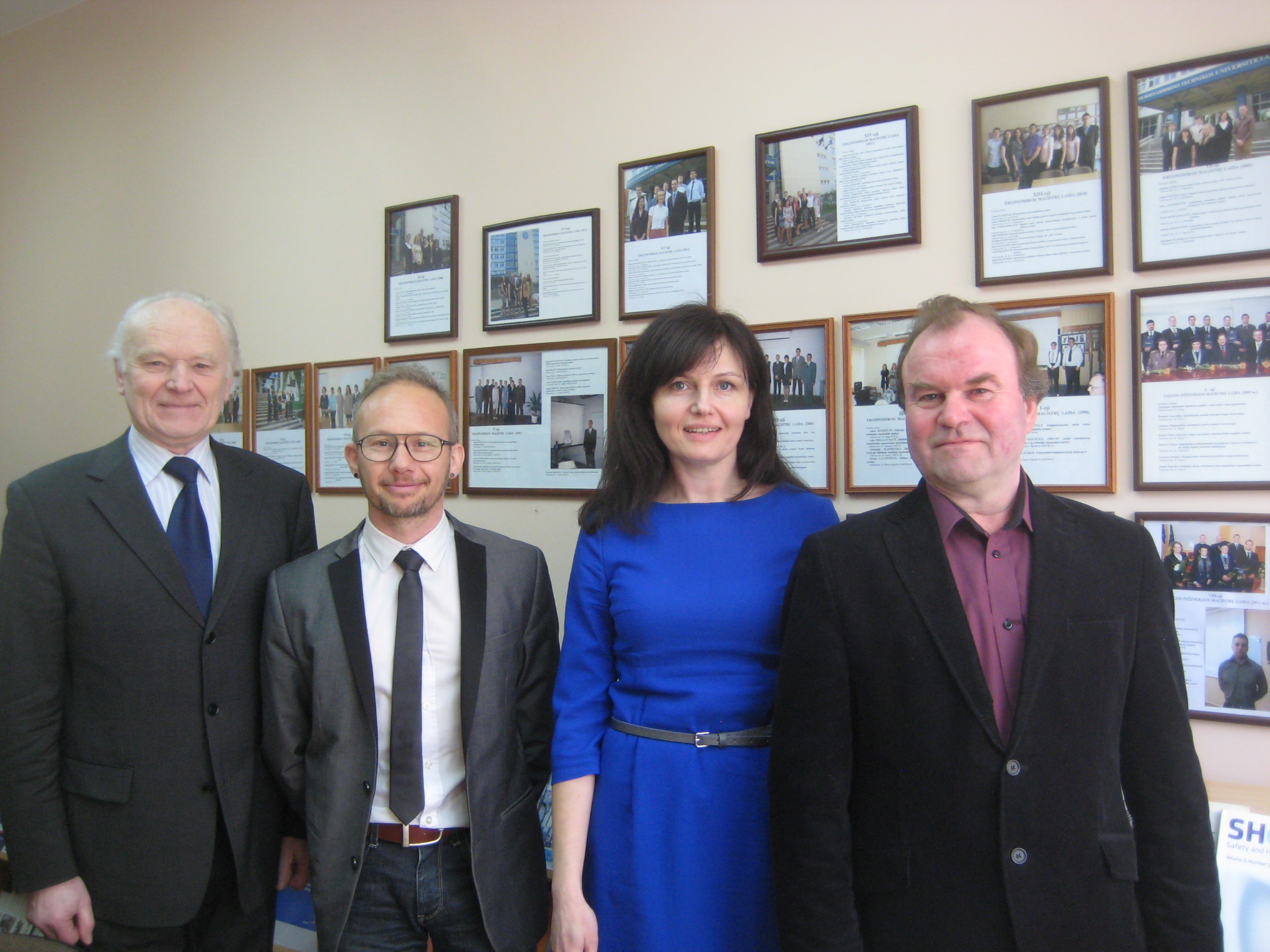
On April 11th, 2016, an official meeting has taken place in Vilnius between FEES and LEA’s Board.

FFES Logo
From left to right, Kazys Algirdas KAMINSKAS (President of LEA), Sylvain LEDUC (President of FEES), Aušra STANKIUVIENĖ (Vice President of LEA) and Arūnas HABDANKAS (board member

The purpose of this event was focused on the membership of LEA to FEES. LEA is born on April 2013 and currently gather 28 members. Association members are university teachers and students, business practitioners in ergonomics, as well as legal persons are the companies providing safety and health services, and the companies, whose in work places are actively applying the principles of ergonomics. Each year are organized a general assembly and council meeting 4 to 5 times per year. There are also four regional clubs. Actually, it does exist some training in ergonomics with a bachelor’s degree in occupational medicine at Vilnius University and a Master’s degree in ergonomics at Vilnius Gediminas Technical University and Kaunas University of Technology.

Next step, an official meeting in RIga with the 3 majors ergonomics Baltics societies (Lithuanian, Latvia, Estonia) on July, 15th, 2016.
Warm welcome and congratulations to LEA’s members

LEA’s E-mail contact: info@ergonomikosasoiacija.lt

LEA’s Website : http://www.ergonomikosasociacija.lt

Chartered Institute of Ergonomics & Human Factors (United Kingdom)

CEO: Ben Peachey E-mail:  ciehf@ergonomics.org.uk

Active FEES membership

What we do

The Chartered Institute of Ergonomics & Human Factors is
recognised through its Chartered status as the professional membership body for
ergonomics and human factors in the United Kingdom.  It is open to
ergonomists and human factors specialists who are qualified, wish to become
qualified or who have an interest in the discipline.  It attracts senior
researchers, academics and practitioners from around the world, who wish to
join as members and to participate in CIEHF events.  CIEHF activities raise
awareness about the broad scope and positive impact of the discipline in all
aspects of life and work

Using
the concept of ‘The Future Human’, CIEHF identifies, organises and supports
innovative and disruptive thinking that can make a significant contribution to
life, wellbeing and performance. CIEHF’s core values drive the way it works:

  • Professional – maintaining the highest professional standards and
    ethical behaviour in research and practice
  • Inclusive – welcoming and respecting difference, recognising
    that diversity contributes to innovative thinking, design and solutions
  • Collaborative – generating and sharing knowledge and expertise to
    enhance integrated design

CIEHF’s mission is “To become the pre-eminent professional home and voice for human
factors” and to do this, CIEHF:

  • Acts to promote and develop the discipline
  • Approves education and training courses
  • Grants membership to those meeting our standards
  • Offers opportunities for Continuous Professional
    Development
  • Operates a Code of Professional Conduct
  • Assesses and accredits consultancies to ensure quality, rigour and competence
  • Provides a conduit for anyone wishing to identify a qualified person or consultancy
  • Organises regular conferences, seminars, lectures and events, open to all
  • Provides leadership and editorial input for at least two international journals
  • Liaises and collaborates with cognate organisations in matters of mutual interest
  • Publishes a quarterly magazine, ‘The Ergonomist’ and other occasional publications, White Papers and guidance
  • Acts as a member of the European and International communities to advance knowledge and adoption of ergonomics and human factors

https://ergonomics.org.uk/about-us.html