University courses on Ergonomics and Human Factors

To browse MSc in Europe, please go to Ergonomics education, training and courses.

A supplementary non-comprehensive list of university courses on Ergonomics and Human Factors:

PhD in Europe

To browse MSc in Europe, please go to Ergonomics education, training and courses.

A supplementary non-comprehensive list of university courses on Ergonomics and Human Factors:

PhD in Europe

PhD in other continents:

MSc in other continents:

If your course is not inculded please send a mail to info@ergonomics-fees.eu

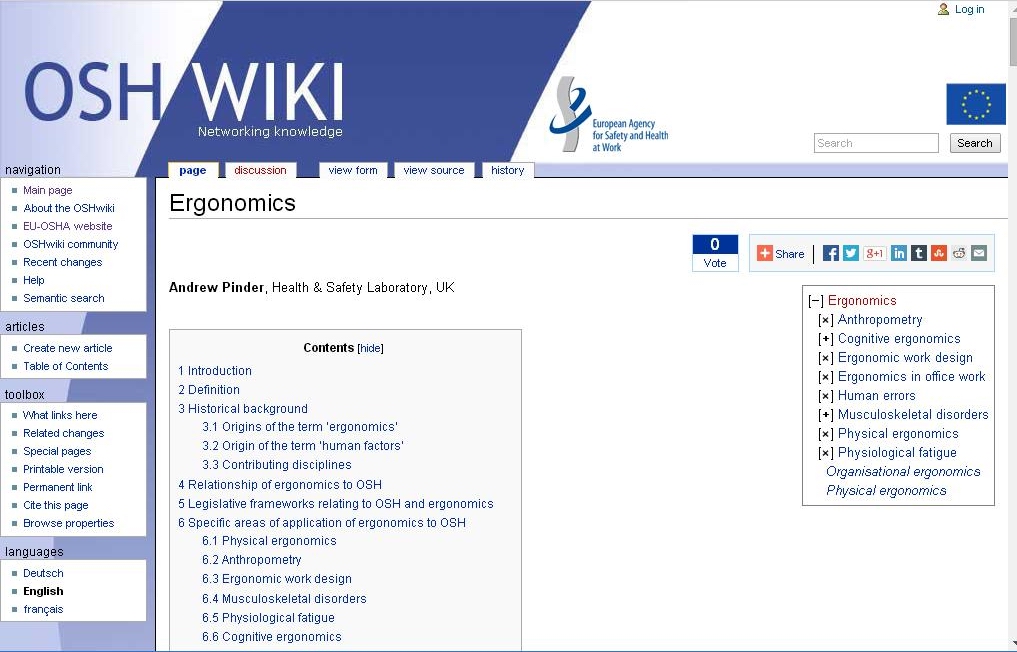
Ergonomics in OSHwiki, the new EU-OSHA knowledgebase

OSHwiki is a reliable source of ergonomics and more OSH information. Contributors include many national organisations for occupational safety and health as well as leading research institutes and accredited authors can create and edit content quickly and easily.

OSHwiki logo

OSHwiki is a reliable source of ergonomics and more OSH information. Contributors include many national organisations for occupational safety and health as well as leading research institutes and accredited authors can create and edit content quickly and easily.

OSHwiki logo

With nearly 300 articles already uploaded by OSH experts, topics found on the platform cover areas such as OSH management and organisation, dangerous substances, psychosocial issues and groups at risk. As a one-stop shop for OSH content, OSHwiki aims to be the go-to resource on health and safety for the OSH community and beyond.

OSHwiki screenshot

There are several pages dedicated to ergonomics, covering physical, cognitive, and organisational ergonomics, the category Musculoskeletal disorders contains 14 pages from “Assessment of physical workloads to prevent work-related MSDs” to “Work-related musculoskeletal disorders among hospital workers

New video on Stress

The Federation of European Ergonomics Societies supports the new two year Europe-wide campaign: ‘Healthy Workplaces Manage Stress’ of the European Agency for Safety and Health at Work (EU-OSHA).

On behalf of FEES Gyula Szabó attended the Campaign Partnership Meeting in Brussels 8 April 2014, where a detailed campaign introduction and the Campaign Video World Premier took place.On behalf of FEES Gyula Szabó attended the Campaign Partnership Meeting in Brussels 8 April 2014, where a detailed campaign introduction and the Campaign Video World Premier took place.


Societal Stakeholders’ Toolbox at CEN and CENELEC

CEN and CENELEC have launched a new section on their website as part of their ongoing efforts to encourage the widest possible range of stakeholders to get involved in standardization activities and help shape the content of European Standards. 


The ‘Societal Stakeholders’ Toolbox’ is aimed in particular at supporting the participation of organizations that are concerned with defending the interests of consumers, protecting the environment, and promoting the health and safety of workers.

Standards, which are documents that set out specifications and other technical information with regard to various kinds of products, materials, services and processes, can have significant impacts on the safety and well-being of consumers and workers, as well as on the wider society and the environment. Enabling organizations representing societal stakeholders to participate in the development of standards helps to ensure that all relevant concerns can be taken into account during the drafting process.

The ‘Societal Stakeholders’ Toolbox’ can be accessed directly from the homepage of the CEN-CENELEC website. It provides practical advice to organizations representing consumers, workers and environmental interests on where to find information about ongoing standardization activities and how they can contribute to the standards development process at national, European and international levels.

The toolbox has been developed by CEN and CENELEC in the framework of their ongoing collaboration with three umbrella organizations that represent the interests of specific interest groups within the European Standardization System.  These organizations are: ANEC (the European consumer voice in standardisation), ECOS (European Environmental Citizens Organisation for Standardisation), and ETUI(European Trade Union Institute – Health and Safety Department).

At national level, many members of CEN and CENELEC are also cooperating with societal stakeholders organizations. Based on existing examples of good practice, CEN and CENELEC are encouraging all of their members (in 33 European countries) to support the active involvement of societal stakeholders in standardization activities and to facilitate this by providing relevant information on their respective websites.

The ‘Societal Stakeholders’ Toolbox’ was officially presented at the CEN-CENELEC New Year Cocktail Reception, which took place in Brussels on 22 January 2014.

NAPO Study resources for teachers

Using the ever-popular Napo character, EU-OSHA, the European Agency for Safety and Health at Work, together with the Napo Consortium has devised a series of occupational safety and health (OSH) education toolkits for teachers, aimed at introducing health and safety topics to primary school children in an educational, yet fun and imaginative way using the Napo clips and creative activities.

Using the ever-popular Napo character, EU-OSHA, the European Agency for Safety and Health at Work, together with the Napo Consortium has devised a series of occupational safety and health (OSH) education toolkits for teachers, aimed at introducing health and safety topics to primary school children in an educational, yet fun and imaginative way using the Napo clips and creative activities.

Each study pack outlines the key messages and learning objectives, offering teachers full details on suggested activity ideas and the resources required, alongside a sample lesson plan that can be readily incorporated into a typical 40 minute lesson.

The resource packs offer suggested lesson plans to educate children aged between seven and eleven on the importance of health and safety. The informative education toolkits feature full instructions, suggested activities and accompanying downloadable resources, to provide teachers and educators support and guidance on incorporating OSH messages into the existing curriculum. The flexible lessons are designed to fit alongside current curriculum subjects to reinforce and assist in their teaching. These include:

  • Personal Health and Social Education (PHSE)
  • Science
  • Road Safety
  • Language learning
  • Arts

Report sheds light on the key factors determining OSH practice

A new report from EU-OSHA describes the contextual and environmental factors that shape approaches to OSH management

A follow-up study to ESENER, the report finds that working environments in EU Member States have a dynamic and changing nature. However, the differences between them are significant. This insight helps to explain why EU work requirements are not applied in the workplace in a universal manner.

A new report from EU-OSHA describes the contextual and environmental factors that shape approaches to OSH management

A follow-up study to ESENER, the report finds that working environments in EU Member States have a dynamic and changing nature. However, the differences between them are significant. This insight helps to explain why EU work requirements are not applied in the workplace in a universal manner.

Event endorsement policy of Federation of European Ergonomics Societies

FEES may endorse a conference on ergonomics, organised by a FEES member society, an IEA member or a professional association when it is considered to be appropriate by the FEES
Executive. Therefore the Executive needs to have insight in the contents and organisation of such an event before a decision has been taken. FEES board will ask the meeting committee and the national society of its opinion if needed.

FEES may endorse a conference on ergonomics, organised by a FEES member society, an IEA member or a professional association when it is considered to be appropriate by the FEES
Executive. Therefore the Executive needs to have insight in the contents and organisation of such an event before a decision has been taken. FEES board will ask the meeting committee and the national society of its opinion if needed.

  • Organisers of an endorsed conference have to pay FEES a fixed fee as follows:
    FEES – member society: no fee;
  • IEA – but not FEES – member society: one time the regular registration fee for that endorsed conference;
  • other professional association: two times the regular registration fee for that endorsed conference.

The organisers of an endorsed conference are permitted to use the name and the logo of FEES in Promotional and other material. They should identify the FEES endorsement as follows: 

LEB


The organisers are allowed to give information about the endorsed conference on the FEES website. If the organisers wish they may ask FEES for support in the organisation of such an event. In that case FEES tries to react as quickly as possible to such a request.

The conference organisers should offer promotional opportunities to FEES and other incentives such as reduced costs of registration for FEES member societies. They should provide FEES with one copy of the conference proceedings, in printed or digital shape for use on the FEES web site as a link.

Requests for endorsement should be submitted to the FEES secretary together with sufficient background information about the event, in general not later than 6 months before the planned date of the event.

Policy towards commercial activities

FEES can take part and work together with organisers of different commercial activities like trade fairs etc. The aims of the trade or other commercial activity should be in line with the aims of FEES and should in general promote ergonomics and be in line with national society’s activities. Direct promotion of products should not occur. In general it is recommended that in the commercial activity should be involved more than one partner if possible. In practice FEES has to ask the national society’s opinion about the activity such as trade fair and act according to that.

Promotion of Ergonomist Registration

Organisers of ergonomics related events, especially events endorsed by FEES, are encouraged to offer opportunity for a presentation to the Centre for Registration of European Ergonomists (CREE) to promote the European Ergonomist Register.

Ergonomics programmes at Óbuda University, Budapest, Hungary

The European Conference on Applied Ergonomics, organized by the Hungarian Ergonomic Society and the Ergonomics Sub-Committee of the Hungarian Academy of Sciences was hosted by Óbuda University, Donát Bánki Faculty of Mechanical and Safety Engineering.

The European Conference on Applied Ergonomics, organized by the Hungarian Ergonomic Society and the Ergonomics Sub-Committee of the Hungarian Academy of Sciences was hosted by Óbuda University, Donát Bánki Faculty of Mechanical and Safety Engineering. The
opening address of the conference, consisting of two English-language sessions,
was delivered by Kenichi Hirose, Senior Specialist of the International Labour
Organization (ILO) Country Office for Central and Eastern Europe, on the
occasion that the ILO publication titled “Ergonomic checkpoints: Practical and
easy-to-implement solutions for improving safety, health and working
conditions” was issued in the framework of the teaching material development project of Óbuda University. Conference participants include Sylvain Leduc,
president of the Federation of European Ergonomics Societies (FEES), Maggie
Graf president of the Centre for Registration of European Ergonomists (CREE)
and the presidents of several European ergonomics societies as well.

In the days to follow the conference, Budapest was the venue of the 43rd session of the council of CREE, operating a register of European Ergonomists. Registration is intended to provide contacts to prominent professionals in ergonomics as well as to
strengthen the ergonomist profession itself. A standardized system of
requirements and an assessment procedure of several stages ensure that holders
of the European Ergonomist title have all the competencies required for performing
ergonomics activities independently and at high standards.
The Harmonising European Training
Programs for the Ergonomics Profession (HETPEP), was adopted in 1990 and since
then it has served as a model for a number of standardized European
professional qualification systems, including the titles of European Health and
Safety Technician and European Health and Safety Manager.